
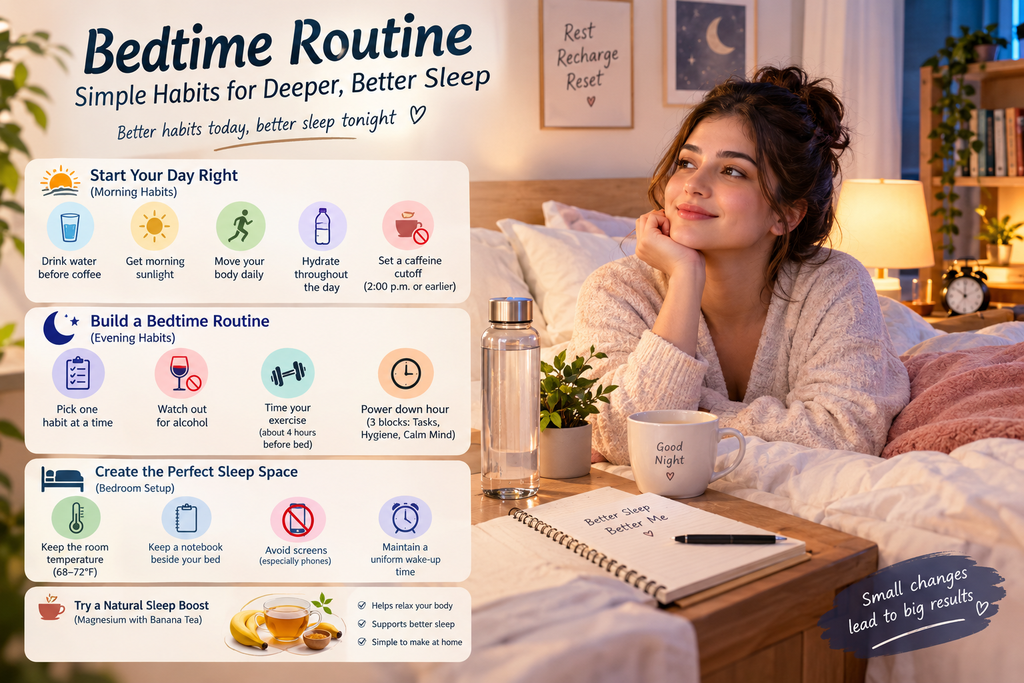
Bedtime Routine: Simple Habits for Deeper, Better Sleep
In most cases, we schedule our days in advance. We rely on calendar scheduling to achieve this. Our nights get no such attention. That is a missed chance. When you add structure to your night, you take control of your environment. You also take control of your sleep. A steady bedtime routine is the easiest place to start.
Why Sleep Needs a Runway
This is because sleep does not happen instantly. The process takes time to occur. This can be compared to an airplane landing. It needs a long runway first. Your evening habits are that runway.
The runway starts earlier than you might expect. It begins the moment you wake up. Sleep doesn’t have to be on your mind all day. Still, a few small choices during the day will shape how you sleep that night.
Start Your Sleep Routine in the Morning
Drink Water Before Coffee
It seems that many individuals turn to coffee the very moment they get out of bed. Try drinking some water first. There are sound reasons for this.
Your brain needs two hormones to pull itself out of sleep. They are adrenaline and cortisol. Both are strong, and together they wake you up fast. Caffeine is far weaker by comparison. So when you drink coffee right away, it adds almost nothing to your alertness.
Give it about 90 minutes. During that time, cortisol and adrenaline begin to drop on their own. Caffeine can then lift them back up. As a result, you get more from the same cup. Wait 90 minutes after you open your eyes before you have your first coffee.
Get Morning Sunlight
Light does more than brighten your day. When it hits your eyes, special cells called melanopsin cells send a message to your brain. That message either releases melatonin or shuts it off. Sunlight tells your brain to shut it off.
This matters because melatonin starts the engine for sleep. You want it running at night. You don’t want it running in the morning.
Watching a sunrise is also good for your eye health. Not everyone wakes up that early, though. That is fine. Sunlight at any point in the morning still helps.
So the order is simple. Drink water, step into the sun, and then have your coffee.
Move Your Body Every Day
Research points to physical activity as the easiest way to improve sleep quality. The bar is low. You don’t need to run a marathon. You don’t need to train like an athlete either.
In short, a body that is a little tired by day rests better at night.
Hydrate Through the Day
Your body needs to be hydrated to sleep well. However, timing matters. If you try to catch up on water in the evening, you will wake up to use the bathroom.
A simple habit fixes this. Remember to fill up your water bottle first thing in the morning. Finish it by lunch. After that, you are in good shape.
Set a Caffeine Cutoff
Caffeine has a half-life that is longer than one would expect. It takes 6 to 8 hours for caffeine to be completely removed from your body. That means half of it is still active after that window.
Here is an example. Say you drink three cups of coffee during the day. By 10:00 p.m., roughly one and a half cups are still in your system. That is plenty to keep you awake.
For this reason, stop caffeine by 2:00 p.m. at the latest. Noon is even better. Caffeine consumption is one of the largest obstacles in getting to sleep, remaining asleep, and obtaining deep sleep.
Build a Bedtime Routine for the Evening
Pick One Habit at a Time
Not all tips provided in this article have to be used. Pick those that you wish to test out. Add one more each month. A slow pace keeps things manageable. Adding too much at once only creates stress.
Building a consistent bedtime routine takes time, so focus on small changes that fit your daily schedule.
Watch Out for Alcohol
Alcohol makes one feel drowsy. That part is true. However, it works against you in the middle and at the end of the night.
Drink enough, and your body becomes anesthetized. That is not real sleep. It is closer to being knocked out. Problems grow quickly after two or three drinks.
Alcohol also raises cortisol. That is the same hormone that wakes you up in the morning. You don’t want it high right before bed.
You can still enjoy a drink with dinner. Only do three things correctly:
- Stick to two drinks only.
- Have some water after each drink.
- Don’t forget to leave at least 3 hours before sleep time.
Time Your Exercise
Exercise is great for sleep. Timing is the catch. A workout raises your core body temperature. Your body then has to cool down before it can release melatonin. A late workout makes that harder.
As a general rule, stop exercising about 4 hours before bed. Night owls may be the exception. The current studies indicate that you can exercise close to bedtime. It all depends on your chronotype, i.e., whether you are a morning or evening person.
Incorporate Power Down Hour in Your Evening Routine
Forget about the last hour of your day. It’s time to relax. Call it the power down hour.
Suppose your sleep time is 11 p.m. You can set your alarm for 10 p.m. It is very easy to forget about time. Then split the hour into three blocks of 20 minutes.
First 20 Minutes: Take Care of Tasks
Use this block for everything that can wait no longer. Send any last-minute emails. Lay out your clothes. Pack backpacks if you have kids. The goal is simple. You want a calm morning, so you do the work now.
Next 20 Minutes: Hygiene
Brush your teeth. Wash your face. Take a bath if you like bathing at night time.
Makeup deserves a special note. Don’t leave it until the last minute. Bathrooms are usually bright, and bright light is full of blue light. Blue light stops melatonin production. Take your makeup off by 8:00 p.m. instead. That way you avoid the glare close to bedtime.
Final 20 Minutes: Calm Your Mind
This block is where much of the magic happens. Lying in bed may be the first real break you have had all day. Because of that, your thoughts rush in. Your heart rate goes up. Your anxiety follows. Sleep then becomes hard.
The fix is a positive distraction. Replace racing thoughts with something calm. You could try:
- Meditation or relaxation
- Prayer
- Reading a book
- A podcast played through pillow speakers
Almost anything works, as long as it is calming.
Set Up Your Bedroom
Your bedroom is part of your bedtime routine. A number of minor modifications will make it much better.
A comfortable bedroom can make your bedtime routine more relaxing and help you prepare for sleep.
Adjust the Temperature
A cooler is nearly always better for sleep. Still, people differ. Some sleep hot. Others sleep cold. Finding your own niche is crucial.
The optimum temperature range of the room should be between 68 and 72 degrees. If you are feeling too warm, you can choose from several alternatives.
First, sleep in less clothing. This helps your body regulate its heat. Then, leave out the socks and keep your feet out from under the sheets. Your feet have no hair on the bottom to help retain heat.
Another way to try is when your partner prefers to be warm. Freeze a water bottle solid. Slip it into a tube sock. Place one on each side of your hips. It helps you cool down without affecting others. You can consider it an air conditioner in your bed.
Should you feel cold, do the opposite. Put on socks and keep your feet covered in the blankets.
Maintain a Notebook beside Your Bed
Notepad costs less but it serves you well. Take it with you whenever you wake up to record your dreams. It also helps at night. Many people get great ideas about work or life right as they fall asleep. Write a few lines. That gets the thought out of your head so you can rest.
Think Before Using Screens
The TV is a gray area. Some people sleep with it on. It can work as a passive, positive distraction. The content flows past you, and you don’t engage with it.
Tablets and phones are another story. Avoid both. If your alarm is on your phone, buy an analog alarm clock instead. Here is why. When you wake up at night, you may grab your phone. Then bright light and scrolling take over.
Maintain a Uniform Wake-Up Time
Pick this as the first habit if you only get to pick one. This is waking up at the same time every single day according to your chronotype.
The importance of consistency is due to the fact that the body is governed by nearly 300 different biological clocks called the circadian clocks. Your whole system then works together.
Add Magnesium With Banana Tea
Many people don’t get enough magnesium. Banana tea is a simple way to add some. You only need a banana and water.
Here is how to make it:
- Wash the outside of the banana.
- Cut off the tip and the stem.
- Cut the banana in half. Keep the peel on.
- Drop both halves into boiling water.
- Boil for five to six minutes, or until the banana turns brown.
- Steep the water, then drink it.
It is said that the peel contains about thrice as much magnesium as the fruit. For taste, one can put in some honey or cinnamon.
There is one caution. The drink also adds a good amount of sugar. It is not a good fit for people with diabetes, people on a keto diet, or anyone avoiding sugar. Guava leaf tea is a good alternative. It has almost no caffeine.
Final Thoughts on Your Bedtime Routine
It’s the difference between having a good night versus a bad one. It doesn’t need to be perfect. It only needs to be steady.
Start small. Choose one habit this month. Add another next month. Over time, these changes build on each other.
Waking in the middle of the night will still happen sometimes. Don’t worry when it does. Stay with your routine, and give it time to work.