
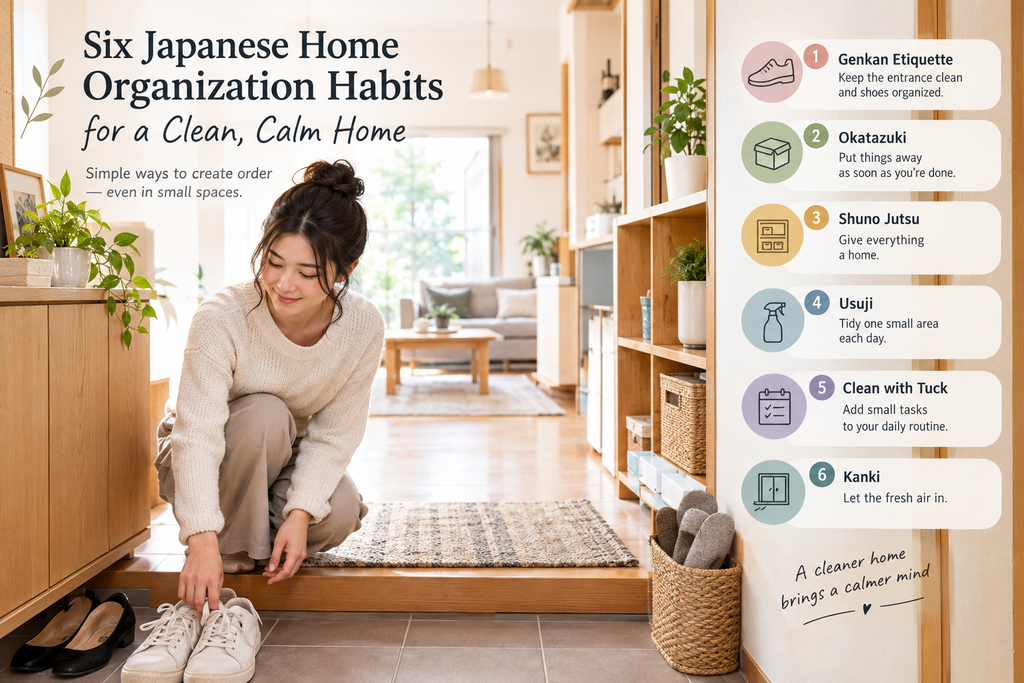
Six Japanese Home Organization Habits for a Clean, Calm Home
Simple ways of organizing one’s Japanese home that will maintain order even in tiny rooms.
Do you ever experience a sense of peace when entering someone’s home? Clean countertops, fresh air, nothing lying around randomly. It is not often something that occurs by chance. Japanese home organization focuses on simple daily habits that keep your living space clean, calm, and clutter-free without requiring hours of work.
Japanese household management is based on minor routines, the kinds of routines that are performed so many times that they cease to feel like work. No big budget. Not one cleaning marathon. Here are six tips that you can adopt, which will work even in a small apartment.
Organizing the Japanese Home Begins at the Entrance Gate
1. Genkan Etiquette
The entrance gets serious respect in Japanese culture. It’s the border between the messy outside world and the clean space you live in.
We all have a doormat and we’re done with that. The entry of the house in Japan is mostly a sunken space called genkan. You keep your shoes in the lower space and walk inside from the higher space using your bare feet. Dust and dirt can never make their way inside.
The habit itself is simple. Remove your footwear before entering the house. They can be arranged properly, perhaps by utilizing the allotted area for shoes. Have some slippers for guests to use. That one move catches most of the dirt right where it starts.
Then there’s the entrance itself. Give it a quick sweep and line the shoes up each day. Just a minute, at most. But it establishes a tone for everything that comes after it, and lets people know straight away that this is a tidy, respectable house.
No step-down area in your place? A mat and a small shoe rack work fine.
2. Okatazuki: Put It Away Right Now
Ever looked at a messy room and felt too tired to even start? Yeah. Okatazuki is for that.
It turns tidying into a tiny, everyday skill. Less of a chore, more like brushing your teeth. The rule fits in one line: put things away as soon as you’re done with them.
Why does it work? Because clutter doesn’t show up all at once. A cup there, a jacket here. Individually, each thing might seem alright, but collectively, they make the room extremely noisy and cluttered.
So stop it early. The book goes back on the shelf when you finish reading. The coat goes in the closet when it comes off. It takes a few seconds, honestly. After a while you do it without thinking, and the weekend cleaning session just disappears. Make “put it back” your default and let it run quietly in the background.
Japanese Home Organization Gives Everything a Home
3. Shuno Jutsu: The Art of Storage
This one grows out of okatazuki. The idea is simple. Every single thing you own needs a place to live.
Think about it. Putting something back is easy when you know where it goes. When you don’t, the item lands on the counter “for now.” And “for now” has a funny way of becoming forever.
A handy trick is to play librarian with your own stuff. Sort things by type. Make use of bins, trays, drawers. One hook for the keys. One organizer for pens and scissors. One tray for the remotes.
What do you get from it? The cleaning process is fast since everything is placed where it belongs. Surfaces stay clear too. And you don’t need anything fancy or expensive. One drawer for electronics, or one basket for blankets, is enough. The point is to decide, on purpose, where things go.
4. Usuji: One Small Area a Day
Japan has the famous big year-end clean, sure. But the real magic happens on all the ordinary days. Little resets keep a home feeling fresh long after the holidays.
With usuji, you pick one small, busy spot. The kitchen counter, maybe, or the bathroom sink. Then you get it back to zero again. Five minutes early in the morning to keep the counters clean and arrange your space. Or tidying the coffee table before going to bed.
Which spot you choose hardly matters. Doing it often is what counts. Each day you have a little victory, and a particular area is never too big.
5. Clean with Tuck into Your Routine
Little by little every day is better than one big attempt. So don’t add new tasks to your day. Attach them to the ones you already do.
Wipe the sink for 30 seconds after brushing your teeth. Squeegee the shower door once you’re out. While brewing coffee, clean the refrigerator shelf. Each takes a minute or two, yet together they stop dirt from piling up.
In plenty of Japanese families this is just normal life. It comes from taking pride in the place you live. And once these tiny chores sit inside your routine, cleaning stops feeling like extra work. A home that always feels fresh? It mostly comes down to patience.
6. Kanki: Let the Fresh Air In
Kanki means a good, strong airing out. In Japan, plenty of people begin the day by opening windows and doors, whatever the season. Yes, even on freezing winter mornings.
It’s not only about freshness. The structure of Japanese homes is so planned that air can move freely inside, and good ventilation will ensure that there is no humidity or mold inside the home. The movement of air maintains things dry and also cleans dust from the environment. This is because in stationary air, water droplets settle on furnishings and fabrics.
Create a cross breeze. Opening the windows from both ends of the house allows the fresh air to push out the stale air. It also creates a fresh outlook for a home. Rather than being burdened by yesterday, it becomes fresh.
It’s easy to fit in, too. Open the windows for 10 to 15 minutes while the coffee brews or while you get dressed. That’s enough to swap the air without freezing your walls in winter.
Where to Begin
Six habits at once is a lot. Pick one. Maybe shoes off at the door this week, then “put it back” next week. Add another when the first one feels normal. Slow is fine.
Concluding Remarks about Japanese Home Organization
The Japanese people always have a clean house due to their awareness and respect for cleanliness. Our manner of thinking is reflected in the environment around us. Thus, when you bring about peace and order in your environment, you do that to yourself, too.
Think of them as minor rituals to keep yourself focused. Home organizing practices in Japan turn routine cleaning into a form of showing concern for your belongings, environment, and yourself.
