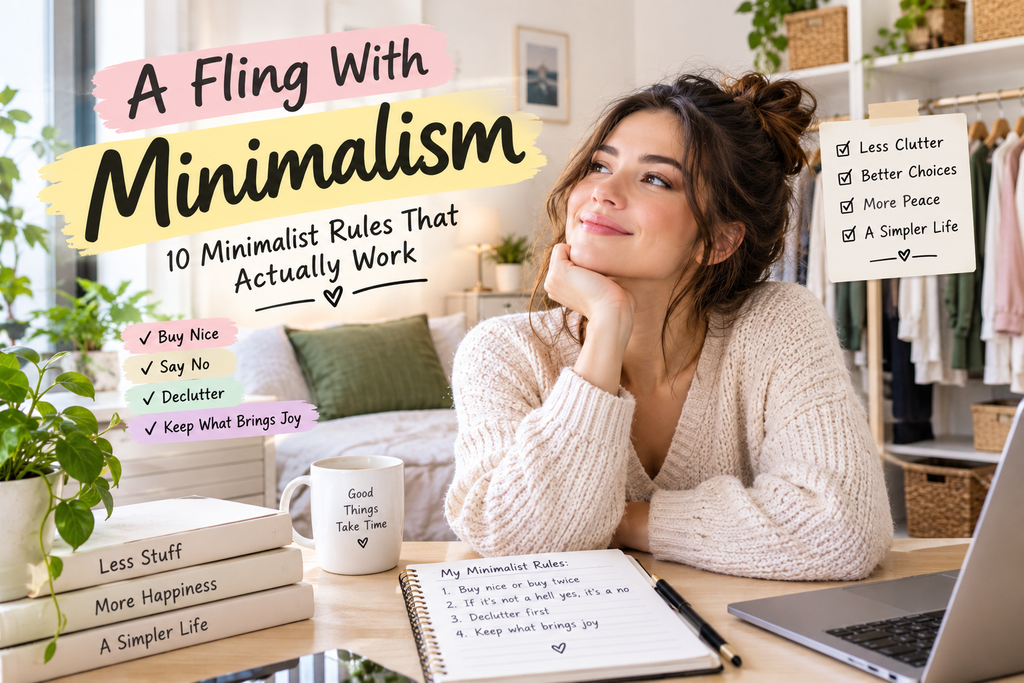
A Fling With Minimalism
So, for the past few years, I feel like we’ve all had a little bit of a fling with minimalism. I dabbled in it for about two and a half years myself. These are the ten minimalist rules that actually work.
I’m Not The Only One
If you want to change your spending habits, change your relationship with your stuff, or simply find ways to streamline and simplify your life and your space, minimalism is really great. But, at least in my experience, it’s also very easy to take it a little bit too far, and I’m not the only one.
A Minimalist-Ish Type Of Lifestyle
Even though I don’t call myself a minimalist anymore (I have way too many clothes for that; the internet police in the comments would really come for me), I definitely lean into more of a minimalist-ish type of lifestyle. There are some minimalist rules that I still stick to, even to this day, and that I still see a lot of benefits from in my everyday life.
Streamline Their Life And Simplify A Little More
So, I firmly believe that you don’t have to identify as a minimalist or make what you consume or not consume your entire personality, but I do think there are some minimalist rules that I think could be helpful for anybody who’s looking to streamline their life and simplify a little more.
The Ten Minimalist Rules That I Think Actually Work
https://bemorewithless.com/begin
the ten minimalist rules that actually work, whether you’re a minimalist or not.
So let’s get into it. Number one of the minimalist rules is “buy nice or buy twice.
Minimalist Rules: Buying Nice In Order To Avoid Buying Twice
And buying nice in order to avoid buying twice not only maximizes the chance that you are buying a higher quality item that you’re going to use and keep for a very long time, but it also, in a way, slows down your buying, because it takes a bit more work upfront to buy the thing.
You Have To Research It
You have to research it, you have to compare brands, you have to go test it out to see if it’s right for you. So, I think having the motto of “buy nice or buy twice,” or my personal favorite, “I’m too broke to buy cheap,” it helps slow down the buying and just ensures that you fill your space and spend your money on things that are higher quality, that are going to last, and things that you’re actually going to use for a long time.
Using The Heck Out Of It
And this doesn’t necessarily mean that you buy the most expensive thing either. I think the key here is to focus on buying the best that you can afford and just using the heck out of it.
Minimalist Rules: If It’s Not A Hell Yes, Then It’s A No
Number two of the minimalist rules is a personal favorite of mine and it is a quote straight from author and entrepreneur Derek Sivers, and that is, “If listening to your gut, it’s not a hell yes, then it’s a no.” For so much in life, it is really as simple as that, because if you allow things into your life that feel lukewarm, I think that’s when it’s really easy to either build up a whole lot of clutter in your life, physical clutter, but it can also lead to things like resentment and burnout, because if you don’t say no for yourself, then people are going to start saying yes for you, and that sucks.
Minimalist Rules: Declutter First
It’s really about listening to your gut, and I think it’s as simple as that. Number three is “declutter first,” to get into the habit of decluttering first before you start organizing.
Organization YouTube, Organization TikTok
Look, I love an organized space, I love organization YouTube, organization TikTok, you know, those like ASMR videos where everybody’s like organizing their fridge and restocking their pantries and things like that.
The First Step Before You Get There Is To Declutter First
It’s very satisfying to watch, but I think a lot of those videos also really focus on buying more stuff to organize your stuff, and sometimes, yeah, you do need to do that, but the first step before you get there is to declutter first.
A Stuff Problem And A Clutter Problem First
A lot of times, if my space is feeling really cluttered up, overwhelming, disorganized, then it usually means that there’s too much junk in the way. I think truly being organized doesn’t require spending a lot of money, or any money at all, it’s often more of a stuff problem and a clutter problem first.
Minimalist Rules: If You Don’t Use It, Evaluate, You Lose It
So start there, get rid of what’s in the way, and then organize it, otherwise you’re just moving stuff around. At that point, if you don’t use it, evaluate, you lose it.
Brings Me Joy, Use, Or Value
I personally live in a small space anyway, so everything that I do own and bring in here needs to meet one of those three criteria.
Some Level Of Maintenance
If it doesn’t, then it’s just taking up space, and it needs to go, because the thing about maintaining a more minimal, organized, or decluttered space is that it does require some level of maintenance.
A One-And-Done Thing
Decluttering and keeping a minimal and organized space isn’t usually a one-and-done thing, it requires some level of maintenance, and your taste and use and need for things is going to change over time.
Minimalist Rules: Wish List And Wait
Number five of the minimalist rules, “wish list,” is to wish list and wait. If you are an OG to my channel, then you know how often I talk about the importance of keeping a wish list. So when I see something that I want, putting it on a wish list is basically a non-negotiable for me at this point, because what it does is that it separates the initial impulse of wanting from the actual buying of it.
The Habit Of Delaying Gratification
Since I started keeping a wish list, it has significantly minimized the amount of things I bring into my space and the impulses that I act upon, and it’s basically gotten me into the habit of delaying gratification.
As Honest With Myself About That Why As Possible
Sometimes I’ll journal a little bit more deeply about it, like I’ll add the price of the item and maybe why I wanted it, and I really make sure to be as honest with myself about that reason as possible.
A Little Bit Of Breathing Space
There’s a lot of reasons why we want certain things, but a lot of times they are really impulsive, and all you need to do is give yourself a little bit of breathing space.
A Huge Trigger Of Wanting Things
This is especially helpful for things like online shopping and when you’re scrolling social media, because that is a huge trigger of wanting things, but it also works to help you shop more intentionally in the future.
The One Everybody Has One
Now, sometimes things here and there still end up on the chair, you know, the one everybody has, but I think it’s a good habit to get into, to minimize the amount of work and overwhelm that needs to be done later on.
Some Bottomless Pit
Plus, you’ll always know where to find things, and you can get as macro about this or as micro as you’d like.
Tangled Cords Or Dongles
Or I always know which adapter I need, where I’m never searching in a big pile of tangled cords or dongles when I’m working in my office, and it helps in places like my wardrobe too, because then my closet stays organized based on garment type and even by color.
Really, Really Easy
So I know exactly where everything is at all times, and it makes getting dressed really, really easy. So if things are put back where they belong, not only are they going to be easy to access, but it’s just going to make your space be that much more functional and feel so much better.
Minimalist Rules: Don’t Buy A Problem
“Don’t buy problems,” number seven, is don’t buy a problem. Oftentimes we buy things in order to solve a problem, but just make sure that thing doesn’t create more problems than it solves.
Hand In Hand With That
Remember the rule of “if it’s not a hell yes, then it’s a no.” I think not buying a problem goes hand in hand with that, because I think it helps you tune in to the feeling of “meh” or “maybe” about something.
Need To Buy More And Do More
Or if you buy a piece that doesn’t go with anything else in your wardrobe, and you feel like you need to buy this accessory, and now this color doesn’t match, you can see how it really easily snowballs into potentially feeling like you need to buy more and do more.
It’s Probably Not For Me
If I start feeling that way about anything I’m buying, or I feel like I really need to rationalize my way into making the purchase, then I know that it’s probably not for me. And this can even simply apply to buying things that you can’t afford.
That Problem Comes With Interest
If you find yourself often relying on credit and using debt to buy things, especially things that are wants and not needs, then, no matter what, you are buying a problem, and that problem comes with interest.
Minimalist Rules: Have A Why Before You Buy
“Have a why,” have a why before you buy. Since now you know all the benefits of keeping a wish list, this is where you can also think about why you want to buy something in the first place. But if you don’t know why you’re buying something, then it’s probably really not worth the money.
Having A Why Behind It
I think one of the cornerstones of intentional buying, intentional living, and intentional spending is having a why behind it, because if you feel like you don’t have a good reason to buy something, then it’s not worth your money.
Your Own Shopping Triggers
I think breaking down the why before you buy is such a helpful exercise, and reflecting about your wants, needs, and even your own shopping triggers, because if I was really honest with myself and dug deep into some of the why’s behind some purchases that I made, a lot of the times they were kind of really embarrassing and not great reasons.
Minimalist Rules: The Spark Joy Rule
Spark joy,” number nine of the minimalist rules, is the spark joy rule. Well, thank Marie Kondo for this one. Basically, if the item does not spark joy, then it’s your sign to get rid of it, and if you’re shopping and looking to buy something new, again, if the item does not spark joy, then you probably shouldn’t buy it.
I Don’t Vibe With That
I like this question because I think with minimalism it’s really easy to get caught up in the primarily utilitarian side of your stuff, as in, a lot of the advice really focuses on keeping only what you need and what you use, and then, instead, they’ll give you advice like, “take a picture of your sentimental item, you don’t need that,” and I just, I don’t know, I don’t vibe with that.
An Honest Spark Joy
I think it’s important and okay to have things simply because you like them, but I think it’s important to also be honest with that. So for me, spark joy has to be an honest spark joy, it has to be that immediate “hell yes” and not that kind of waffling, “meh, I’m not sure, I don’t know” type of feeling.
Let Your Stuff Get Away From You
Because I think the spark joy rule is a really easy one to let your stuff get away from you, but I think it’s just a bit more of a gentle and realistic approach to whether or not you should keep something or even bring something in.
Minimalist Rules: Pay In Full
And finally, “pay in full,” number ten of the minimalist rules: if I can’t pay for it in full today, then I can’t afford it. We live in such an instant gratification society, and a lot of us don’t want to hear the word “no,” let alone tell ourselves no.
We Don’t Want To Wait
And that’s where I think it’s really easy to get caught up in reliance on credit cards or using buy-now-pay-later apps like Afterpay and Klarna, because we don’t want to wait. And, coming from a former shopaholic and stuff hoarder, I did this all the time.
I Had None Of It
When it came to the skill of delaying gratification, I had none of it, and I used things like credit, and it’s because I didn’t want to tell myself no. But I find the more you do that, and the more you delay gratification, being able to pay for something in full is a way to implement that.
Begin With
It just simply forces you to slow down and reflect on whether or not you even want that thing to begin with. I can’t tell you how many times I absolutely convinced myself that I needed something, and by the time the package arrived, I didn’t even know what it was I ordered.
Bleeds Your Bank Account Dry
This really goes to show you just how much impulse buying and acting on those impulses, aka not delaying that gratification, basically bleeds your bank account dry and clutters up your space at the same time.
Makes The Purchase That Much More Intentional
So if I want something, yes, I put it on the wish list, yes, I wait, but I also need to be able to fully pay for it, and if I can’t, then I have to come up with a plan to save for it, and even doing that in and of itself makes the purchase that much more intentional.
More Intentional In Your Life
So those are the ten minimalist rules that I think actually work, and that I still live by even to this day. I don’t think you need to be a minimalist to benefit from some of the habits and lifestyle changes that it does promote, and this is just an example of how I use it in my own life. Let me know some rules or habits that have helped you become more intentional in your life.

3 Comments on “Minimalist Rules That Actually Work to Simplify Your Life”