
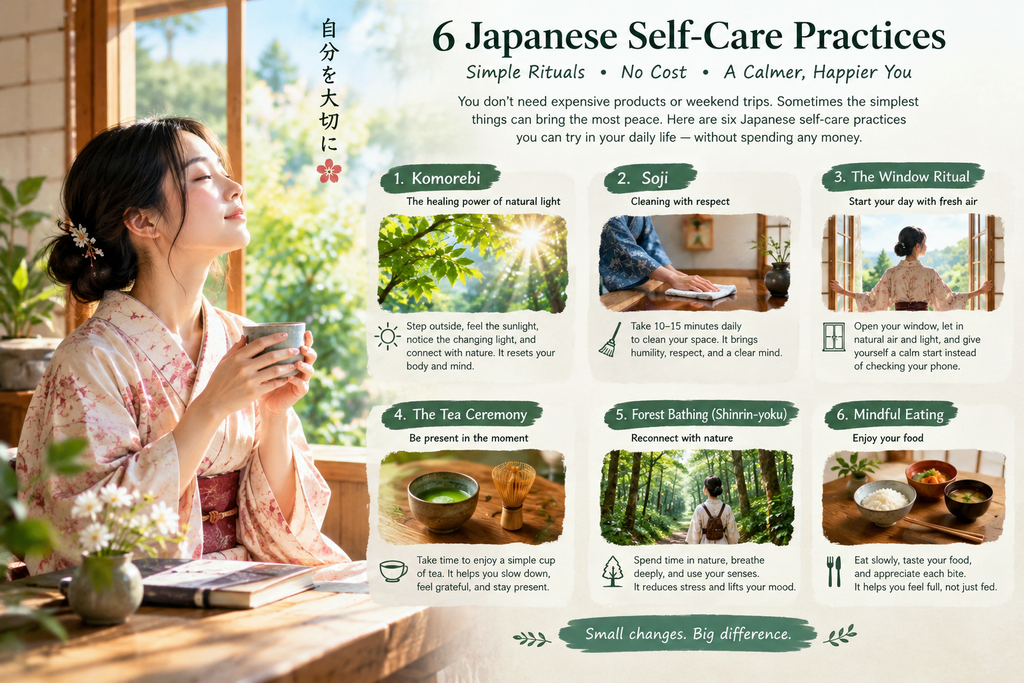
It is not necessary for self-care to involve costly skincare products, luxurious spa services, or even weekend trips somewhere else. Sometimes, the simplest things can be done on a regular basis. These things may help one relax. They may also rekindle a connection with the world around them and restore harmony in one’s life. In fact, the culture of Japan provides a number of self-care techniques. They are associated with mindful living, embracing nature, cleansing, and sense awareness. Below, six Japanese self-care practices are mentioned. One can incorporate them into modern life without spending any money.
Well-Being Into Something People Buy
When we hear the expression “self-care,” we think of fancy spas, weekend getaways, and pricey skincare products. By doing this, we have turned well-being into something people buy. We do this instead of making a life we don’t always want to leave. We see rest as a reward for surviving exhaustion. Therefore, this kind of self-care is reactive.
A Different Way of Thinking
We wait until stress is at its highest point. Then we try to get rid of it by eating. However, there is a different way of thinking. It is an approach from Japan that sees care as a daily practice. It is not a special event on the calendar. From this point of view, real self-care is always the same.
Japanese Self-Care Practices: No Cost and No Need to Travel
There is no cost and no need to travel. Instead, it needs something much more rare and expensive these days: your full attention. Japanese culture has created rituals over hundreds of years of Zen tradition. These rituals help people stay in the present.
A Biological Need That We Often Ignore
They work because they meet a biological need that we often ignore. It is the need for rhythm, order, and a sensory connection to the physical world. In this article, we’ll look at six old Japanese self-care practices. They have been changed for modern life. They will help you get out of your head and back into your body.
Japanese self care practices 1:Boxes of Fake Light
https://health.nih.gov/health-topics/healthy-sleep
Komorebi, the biology of light. Scientists say that most of us live an indoor life. For example, we wake up in a room. Then we get in a car or subway. Next, we go to work in an office. After that, we go back to the living room. In short, we are living things that live in boxes of fake light.
Sunlight Shining Through the Trees’ Leaves
This makes you feel a little lost. We lose track of time in our bodies. Our sleep gets worse, and our anxiety goes up. This is where the idea of komorebi comes from. It is a Japanese word that means the sun shining through the tree leaves. However, it can’t be translated.
The Way Nature Dances
It’s not just sun. It is the interaction between light and shadow, movement, and dance of nature. The Japanese people value this phenomenon because it is beautiful. They also value it because it gives them an opportunity to connect with nature briefly.
Look for Natural Light on Purpose
The important thing to do here is to look for natural light on purpose. Not only does this give you vitamin D, which is good for your body. It also lets you reset your internal clock.
Part of a Bigger Cycle
For instance, step outside during the morning. See the way the sunlight touches the earth. Then notice how the sun’s light changes in the afternoon. In this way, you’re sending a signal to your body that there is something greater that you belong to. Komorebi provides living light that is gentle for our eyes.
Still Living Things
In a world full of bright screens and static pixels, it is a visual reminder. It reminds us that we are still living things. This is true even though there is concrete all around us.
Japanese self care practices 2: Cleaning Has Mutual Respect
Soji, cleaning has mutual respect. In Western society, housework is considered drudgery. People see it as something to get over and done with. Or they want someone else to do it for them. However, this is a very common thing in Japan. It happens in many different places such as schools, temples, gyms, and even offices.
Stop All Work for a Short Time
The main idea behind this cleaning time is to stop all work for a short time. In this way, people who use the space can clean it. The goal is to keep it neat for yourself and for others. People treat cleaning with respect.
Humility, Respect, Discipline
It is one that imparts humility, respect, self-discipline, as well as cleansing both of mind and spirit. Good cleaning of communal areas instills teamwork and responsibility, regardless of who one is. Moreover, we feel more in control when we do soji. Soji means morning cleaning.
10 to 15 Minutes Every Day
This is to make sure that you take ten to fifteen minutes daily. Perhaps do it in the morning. Use the time for some manual activity. For example, clean your desk, sweep, and dust books. Choose also a specific corner of your house to do your cleaning.
Look after Yourself and Your Home
It’s good to clean your surroundings since they keep you alive. Also, a clear space gives your mind a break right away. Don’t stop cleaning until you’re done. In short, cleaning is a way to take care of yourself and your home.
Japanese self care practices 3:The Window Ritual
The window ritual. What do you do to start your day? For most of us, the first thing we do is pick up the phone. We let the world in on our private space before we even get out of bed. It brings bad news, work, stress, and the perfect lives of people you don’t know on social media.
Opening the Window
As a result, we begin the day in reactive mode. This means we’re already late and anxious. Opening the window is the other option suggested here. It may seem small. However, it is a strong way to mark a change. Also, air circulation is very important in Japan. It keeps energy from getting stuck.
Before You Look at Any Screens
First, as you get out of bed, make your way towards the window. Open it fully before you stare at the screen. Next, allow the stale air, full of carbon dioxide, to escape through the window. Then let the new morning air come in. Finally, touch your skin to feel the temperature.
Choose How to Start It
Also, listen to the sounds of nature or the city waking up. Look at the sky. This simple act takes less than a minute. Still, it sets a limit on both your body and mind. It tells your brain the day has begun, and “I’m going to choose how to start it.”
Ownership of Your Morning
It’s a way to take ownership of your morning. You do this before giving it to the world. In other words, it is giving up a digital connection for one that is more physical.
Japanese self care practices 4:Space as a Mirror of the Mind
Seiri and Seiton, space as reflection of the mind. Have you ever realized that you feel stressed and nervous while sitting in a messy room? It occurs because all the mess around you is nothing but noise that you can see.
A Small, Silent Signal of Distress
For example, every item that isn’t where it should be sends a small, silent signal of distress to your brain. So does every piece of paper on the desk and every piece of clothing on the chair. As a result, this slowly drains your mental battery. In Japan, organization is made up of different ideas.
Two of the Most Important Ones
Seiri and Seiton are two of the most important ideas of organization in Japan. They come from the Japanese workplace. However, they work just as well at home. Seiri is the skill of choosing. It means figuring out what is important and what is not.
All Is Kept In Its Place
The objective is the removal of all excesses, creating space, eliminating distractions and reducing cost. Meanwhile, Seiton is the arranging of items in such a manner that each remaining item has a place.
Saves Time and Effort
This involves placing remaining items, as per Seiri, in their proper places and in an orderly manner. This will be useful in ensuring that items can easily be located, identified, and used. Hence, it saves time and effort.
Space Maintenance Is the Self-Care Practice
Space maintenance is the self-care practice here. Try applying this method to a small space. For instance, you can utilize your office desk or bed table. In this way, you will be establishing a more practical and attractive environment. You do this by eliminating unnecessary things.
Japanese self care practices 5:Monko and Presence
https://www.nccih.nih.gov/health/aromatherapy
Monko and presence. This is an era in which appearance holds great importance in our lives. However, we ignore our other senses. We focus so much on what we see. In Japan, though, there is a practice of introspection and contemplation. It uses another important sense: smell.
Listening to Incense
Smell is the only sense that goes straight to the limbic system. This is where our memories and emotions are stored. It goes there without going through the brain’s rational filter. Monko is a Japanese tradition. It literally means “listening to incense.”
To Listen Instead of To Smell
It is a practice that includes learning about the history and poetry of different scents of incense. It is not just about smelling it. Instead, it’s like hearing it. Notice that “to listen” is used instead of “to smell.”
A Concept from Zen Buddhism
It consists of developing the mind through the smell of fragrant wood. It is a Zen Buddhist principle. However, I can’t help but think that saying “listen” instead of “smell” might also be a Japanese thing. This applies when talking about incense.
The Voice of the Stone
For example, “listening to the voice of the stone” is a phrase that traditional stonemasons in Japan use. Similarly, woodworkers say “listening to the voice of the tree.” This is an attitude of listening to the voice of nature through each material.
Attention and Respect
It is an approach in dealing with the world. Here, materials do not function as passive entities. Rather, they are active participants that require reverence and concentration. In addition, you can help yourself relax your mind and reduce your level of anxiety through new senses.
Misogi, Water and Purification
Practice 6: Misogi, water and purification. Finally, we get to sensation through another sense, which is touch. It is the biggest organ in our body. We touch water dozens of times a day.
Flying Blindly
We bathe, wash our hands, and clean our plates. However, we do these things on autopilot. Our minds are already on the next thing on the list. Meanwhile, water is very important in Japanese culture for purification. This is called misogi.
Under Ice-Cold Waterfalls
This process of purification enables one to be free from dirtiness and unnecessary baggage. As a result, one becomes clean of body and mind. Such rituals are mostly conducted amidst nature, like beneath cold waterfalls. This indicates some relationship to nature and the sacred.
A Traditional Misogi
The misogi is performed by the person entering a body of natural water such as a river or waterfall. Then the person performs a number of cleansing rites. They include praying, chanting, and meditating while submerging himself into the cool water.
A Blank Canvas
The cold water is supposed to cleanse the body and mind. The individual will be prepared to meet fresh challenges with a clean slate. The act is full of symbols. These have become a modern idea of personal overcoming. Facing a freezing waterfall is very hard and challenging for the body. Nevertheless, it must be said that it is beneficial to both mind and body as well.
Revised Concentration
To use water as a means of sensory stimulation and mental cleansing is an act of self-care. It is an experience that allows you to feel better and to unwind. As a result, this will leave one’s body on alert and their mind clear. They will be prepared for the demands of everyday life with newfound clarity.
You Don’t Have to Buy Anything
What is the similarity between all these six elements (light, cleaning, air, order, smell, and water)? First, you don’t have to purchase anything from any of them. Second, you don’t have to flee from reality for any of them. Finally, they all use the body to quiet the mind.
Pick One of the Japanese Self-Care Practices
A lot of modern advice tells us to think positively to deal with stress. However, we are animals that live in the real world. We need things that stimulate our senses to feel safe. Also, you don’t have to start all of these Japanese self-care practices right away. Pick one.
Start Living It as a Practice
Maybe opening the window. Maybe you should clean your desk on purpose. You stop thinking of self-care as a product. Instead, you start living it as a practice. You stop trying to run away from your life. Then you start living it.
Conclusion: Japanese Self-Care Practices
Self-care doesn’t always have to include fancy products or processes. The above six self-care practices practiced by the Japanese help demonstrate that very easy practices can help bring balance into your daily life. Some of these practices include exposure to natural sunlight and keeping one’s environment clean, breathing fresh air and organizing your environment, as well as enjoying pleasant fragrances and water consciousness.


One Comment on “6 Japanese Self-Care Practices That Calm Your Mind and Body”