
Your Perfect Routine
What does your perfect routine actually look like? Maybe there are habits you’ve always meant to start but never got around to. Or changes you kept trying to make that just never stuck. And then, of course, there are the bad habits — the ones you’d love to erase completely.
Three Foolproof Principles
These three foolproof principles are exactly how to build a routine that sticks. They’re the same ones that allowed me to graduate medical school while growing a six-figure business, working full-time as a doctor, and still being the happiest, healthiest version of myself. Honestly, it’s far more straightforward than you’d expect.
No Woman Left Alone
First: No Woman Left Alone. Building a routine is actually simple — it’s just a matter of stacking habits together. However, if you treat each habit as a solitary event, detached from the rest of your day, you’re setting yourself up to fail.
A Chain Of Events
Instead, every habit needs to connect into a chain of events, ideally ending in some kind of reward. For example, one habit completely transformed my life. It let me keep working full-time as a doctor while also running a side project.
Two Hours’ Work
Every morning, I work for two hours between 5:00 a.m. and 7:00 a.m., before heading into work at 8:00 a.m. Honestly, none of that sounds appealing on paper. Yet there’s one small factor that’s kept this habit alive.
Muscle Memory
Each morning, I trigger a chain reaction so built into muscle memory that I could do it with my eyes closed. First, I make my morning smoothie. Then, I sit at my desk with it — and the best part is, it actually tastes great.
A Habit Loop
Without even meaning to, I created a habit loop. If you’re unfamiliar with the concept, don’t worry — it’s simple. The cue is waking up and making my smoothie. The craving is how good it tastes. Then, the response becomes my two-hour morning flow state.
As A Reward
On top of that, I keep a task list next to my laptop every morning, crossing off items with a red pen as a reward once they’re done. Just like that, a complete habit loop formed — one I never intentionally set out to build.
Never View Habits In Isolation
So, if you want to build a routine that lasts, never view habits in isolation. Instead, frame them within a habit loop. It can be tricky to brainstorm each of the four stages, but the concept is popular for a reason — search online, and you’ll find countless examples to try.
Bombarded By The Habits
Meanwhile, on social media, we’re bombarded with habits we “should” be doing — wake up at 4 a.m., run 10K, take cold showers, journal, drink green juice, meditate. Honestly? No.
Contribute To The Goals
Instead, focus only on habits that actually support your specific goals. For instance, if your mental health needs attention, prioritize gratitude and movement. If physical health is the goal, build a nutritious breakfast habit and track your steps.
Brain Dumping
Similarly, if productivity is your focus, try brain dumping or building a morning flow state. Either way, don’t try to do everything at once just because social media says so.
Forgiveness
The third and most important principle is forgiveness. For example, I recently traveled to America for a family wedding. By the time I got back, jet lag made my 5 a.m. wake-up impossible.
Absolutely Not
So, was that a sign to abandon the habit I’d worked so hard to build, just because I felt guilty? Absolutely not.
15 Minutes Earlier
Instead, I simply tracked my wake-up time each day and aimed to wake 15 minutes earlier every morning until I was back on schedule. Interestingly, it took far less time to rebuild the habit than it did to create it originally.
The Number One Failure
This is exactly why, when people talk to me about failed habits, the same story comes up. They build a habit, miss a few days, then spiral into guilt — which stops them from simply starting again.
Doomed To Fail
Here’s the truth: every routine is, at some point, doomed to fail. The habits you’ve spent weeks building will eventually crumble.
Beautiful Memories
That might happen because of a holiday, a birthday, or anything that disrupts the everyday routine — which, ironically, often includes life’s most meaningful moments. After all, when you’re 90, you won’t be reminiscing about your 5 a.m. wake-ups. You’ll be talking about your friends, trips, and memories.
Coexisting Harmoniously
Still, ironically, it’s often the routine — the journaling, the healthy habits — that helped you get to 90 in the first place. So, it’s not about choosing one over the other. It’s about letting both coexist harmoniously.
Get Straight Back To It
Therefore, when your routine inevitably slips because you’re enjoying life, don’t spiral. Instead, be proud of how long you stuck with it, and simply get back to it.
Secretly Destroying Your Day
Now, here’s something worth considering: your “perfect” routine might actually be destroying your day. Waking at 5 a.m., journaling, cold showers, two-hour deep work sessions — realistically, nobody sustains all of that consistently.
Exhausted, Overwhelmed
So, let’s cut the noise and build a routine that works for real life — no aesthetic lies, just results.
The Instagram Version Of You
Here’s why most routines fail: they’re not designed for you. They’re designed for the Instagram version of you — the one with 26 hours in a day who never gets tired.
Step By Step
That’s exactly why we need to break this down step by step. This is genuinely how to build a routine that sticks, rather than one that just looks good on paper.
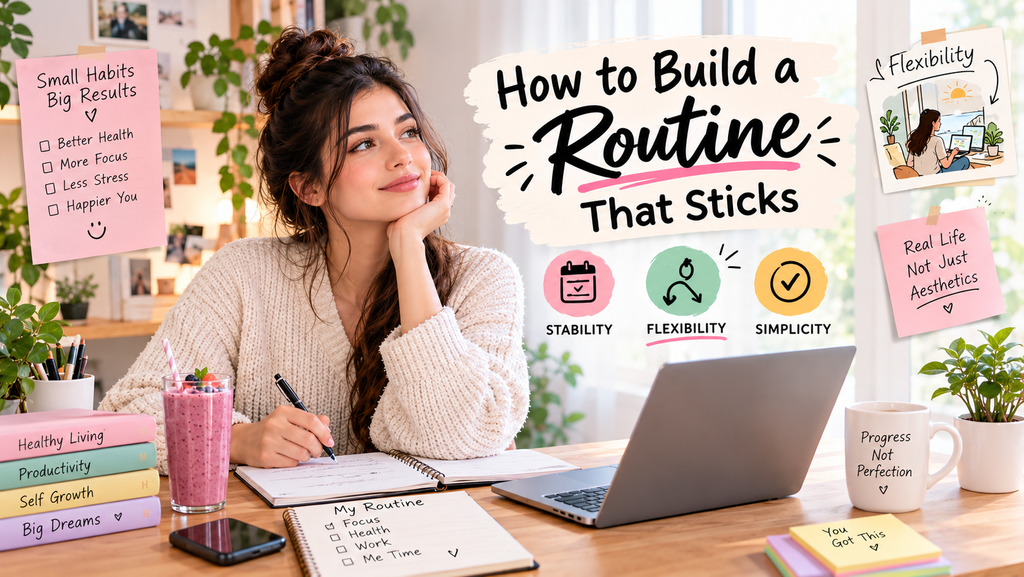
Stability, Flexibility, Simplicity
There are only three pillars your routine truly needs. First, stability, so your brain knows what’s next. Second, flexibility, so life doesn’t derail you. Third, simplicity, so you don’t quit by day two.
Aesthetic Productivity Robots
Once your routine has these three elements, you’re already ahead of the productivity perfectionists who fall apart the moment their almond milk runs out. From here, it’s also worth building your day around energy rather than the clock, since none of us have identical energy levels at 9 a.m.
Night Owls
Some people, meanwhile, are night owls — most creative once the world goes quiet. Either way, your job is simply to match tasks to your natural energy.
Match Tasks With Your Energy
So, during high-energy periods, tackle deep work. During low-energy periods, handle lighter tasks like chores or replies. Ultimately, stop forcing yourself into someone else’s rhythm, and start following your own.
The Four-Block Routine
This is where the four-block routine comes in. Rather than micromanaging every hour, structure your day into four simple blocks.
Focus Block And Admin Block
First, a focus block — 90 to 120 minutes for deep work like studying or building. Second, an admin block — 45 to 60 minutes for smaller tasks like emails or errands.
Recharge Block And Freedom Block
Third, a recharge block for movement, rest, or stretching. Fourth, a freedom block — guilt-free time for whatever you enjoy.
Lightweight, Flexible, Repeatable
Ultimately, you decide when each block happens, based on your own energy — not someone else’s idealized morning routine.
Three Routine Killers
Beyond structure, three habits quietly kill most routines. Let’s break each one down.
Perfectionism
First, perfectionism — the “if I can’t do it perfectly, I won’t do it at all” mindset. In reality, a messy routine done daily beats a perfect plan followed twice a week.
Comparison
Second, comparison. Someone else might wake up at 4 a.m. and juggle 17 habits — but that’s their life, not yours.
Keystone Habits
Instead, focus on keystone habits. Ask yourself: which 20% of tasks deliver 80% of your results? Usually, that’s just three to five habits — sleep, movement, planning, and maybe creating. These few habits can genuinely run your life; everything else is just noise.
Burned Out From Chasing Perfect
So, if you’re feeling stuck, you’re likely not lazy — you’re burned out from chasing perfection and comparing yourself to someone else’s highlight reel.
Permission To Be Human
Ultimately, once you build a routine around your actual life — with the right structure, mindset, and permission to be human — you’ll finally feel in control.
Your Anti-Fluff Routine Plan
So, here’s the plan: first, design around energy, not hours. Second, use the four blocks. Third, track your 80/20 habits. Fourth, leave room for real life. Want a real-world example? Check out these high-maintenance beauty habits that show exactly how small, consistent routines make a big difference.
Together, these steps are ultimately how to build a routine that sticks — without guilt, without fluff, and without chasing perfection.

6 Comments on “How to Build a Routine That Actually Sticks (No Fluff)”