
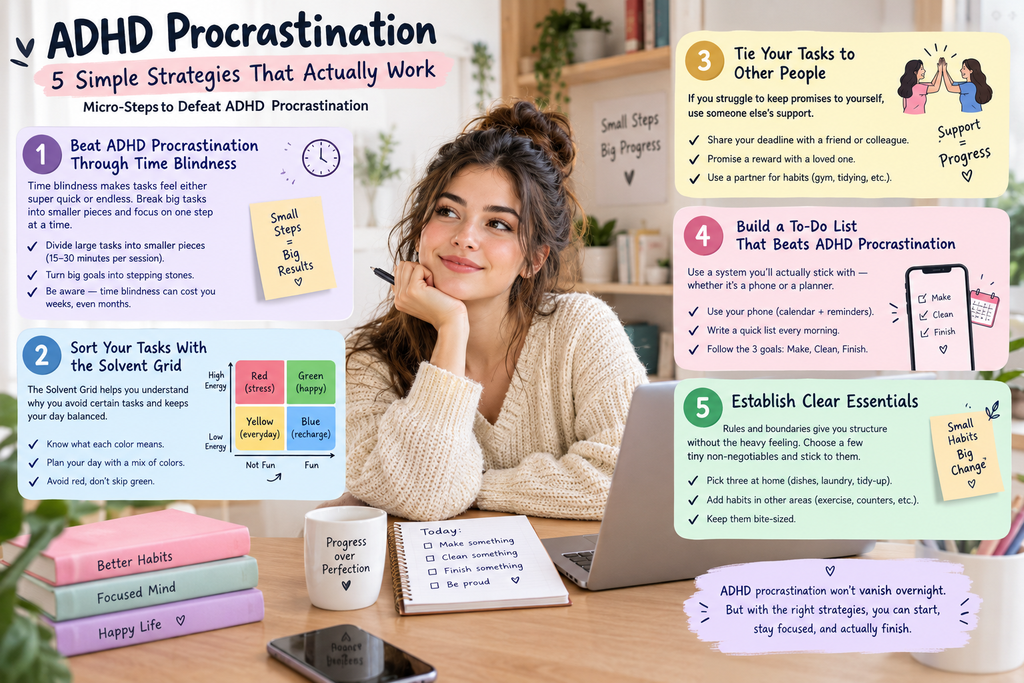
5 Simple Strategies That Actually Work
Micro-Steps to Defeat ADHD Procrastination
ADHD procrastination is a common battle, and it usually travels with other executive function problems. For a lot of people it shows up every single day. The good news? It can change.
Don’t need a total life Transform . A few small pivots are enough to make starting feel less painful. Fortunately, Here are five strategies that fit into a normal routine and help you begin, stay focused, and actually finish.
Strategy 1: Beat ADHD Procrastination Through Time Blindness
Time blindness is behind a lot of procrastination. You can’t really feel how long something will take, so your estimates go wrong in two ways.
Fun things look quick. You figure a project will take ten minutes, then glance up and ten hours are gone.
Boring things look endless. A tiny chore turns into a six-week ordeal in your head. So why bother starting? That’s task paralysis, and it’s exhausting.
Divide Large Tasks into Smaller Pieces
Make the task smaller. Choose an item where there is a clear endpoint. Most people will be successful at 15-30 minutes per session.
For example: Suppose you decide to arrange the entire kitchen. Don’t pull everything out and hope to finish by dinner. Just do one drawer. Or one cabinet. That’s the goal for the day.
You might do three drawers, or you might stop after one. Both count. You won’t end up with a giant mess, and you get a quick win each time. The wins will accumulate, making the next challenge simpler to start.
Transform Big Goals Into Stepping Stones
Big goals work the same way. Divide the problems in small chunks and write each chunk down. A goal looks far less scary once you can see the steps on paper.
Then take one stone at a time. Before long, the big goal doesn’t feel so big.
Time Blindness Can Cost You Weeks
It’s not only about lost hours. Time blindness can swallow days, weeks, even months, and you barely notice.
Maybe you realize you need a haircut and tell yourself you’ll book soon. Days slip by. Then weeks. Suddenly a couple of months have passed. Small, clear steps stop that from happening.
Strategy 2: Sort Your Tasks With the Solvent Grid
The Solvent grid is a different way to look at your to-do list. It comes from the book Your Brain’s Not Broken. It shows why you avoid certain tasks, and it helps you balance your day.
Picture a grid. One line runs from not fun to fun. One goes from low energy to high energy, where in this case the energy is emotional energy. Those two lines give you four colors: yellow, red, blue, and green.
Yellow: Low Energy, Not Fun
Yellow is the everyday stuff. It takes little emotional energy and it isn’t fun.
Red: High Energy, Not Fun
Red is what you’ve put off for too long. It’s stressful, so the emotional energy is high, and it’s definitely not fun. Picture the tax office knocking on your door.
Blue: Low Energy, Fun
Blue is fun but low energy. Watching Netflix or scrolling Instagram fits here. A little bit can recharge you. Too much, though, and you feel drained and find it harder to get going again.
Green: High Energy, Fun
Green is the sweet spot. High emotional energy and high fun. For lots of people that’s a hobby, like cooking or gardening. Your green might look completely different, and that’s fine. Pick whatever lights you up.
ADHD Procrastination and The Solvent Grid
Plenty of people skip green time, and it backfires. If you never do what you love, you’re basically punishing yourself.
Meanwhile, the yellow tasks stack up. Leave them long enough and they turn red. Stress climbs, you feel worse, and you grab blue to recover. Then you’re stuck in a loop that doesn’t help anyone.
Once you can see the pattern, you can break it early.
Plan Your Day With the Grid
A balanced day might go like this. Start with something yellow, like making breakfast. Throw in a load of laundry, still yellow. Then take a break with tea and a quick scroll. That’s blue.
After the break, knock out a couple more yellow tasks. Mix in some blue and some green. Steer clear of red when you can. If red does show up, deal with it fast.
Just knowing which color you’re in makes planning easier. You’ll feel less stressed and get more time for things you enjoy.
Strategy 3: Tie Your Tasks to Other People
Some people struggle to keep promises to themselves. Tell yourself you’ll finish by Friday and, honestly, letting yourself down feels fine. Letting someone else down? Not a chance.
The Four Tendencies framework calls this type an Obliger. If that’s you, use it.
Share Your Deadline
Tie a big task to another person. Agree on a deadline with a friend or colleague and tell them what you plan to finish. Now someone’s waiting on you, so you’re far more likely to start early.
Promise a Reward With a Loved One
Rewards work too. Tell someone at home, “If I finish this by Friday, we’re getting ice cream.” Or, “If I get this done today, we’re watching a movie tonight.”
Now the task isn’t just yours. Somebody else cares, so you show up.
Use a Partner for Habits
Similarly, Habits work the same way. Want to exercise more? Ask a friend to meet you at the gym three nights a week at 7. You won’t want to bail on them. Having a guest coming over is a great tidying deadline, too.
So what have you been avoiding? Ask yourself who you could tie it to.
Strategy 4: Build a To-Do List That Beats ADHD Procrastination
Some people love planners and some don’t. Both are fine. What matters is using a system you’ll actually stick with.
A lot of us have bought planner after planner. Then we forget to open them, forget to check them, and forget where they went. If that sounds like you, try your phone.
Use Your Phone
A digital calendar with alerts and reminders is hard to forget. Put anything important in there. You can pair it with a voice assistant and add events by voice the second you think of them.
If you do like a planner, keep it light. Stick to three real priorities a day. One small extra is okay, but that’s it.
Write a Quick List Every Morning
Moreover, write a short list each morning. Deciding what goes on it can feel like a chore, though. Here’s a trick.
Build the list around three goals. Make something. Clean something. Finish something.
Make Something
Pick one thing for your work or a creative project. A small thing is fine. The point is to move something forward every day.
Clean Something
Pick one cleaning task. Vacuum, dust, whatever you feel like. No pressure here.
Finish Something
Lots of us start projects and never finish them. So ask, “What can I finish today?” Find something small you’ve been putting off and wrap it up.
Strategy 5: Establish Clear Essentials
Rules and boundaries help many people with ADHD. Without them, the day just drifts. Too much structure can backfire, though, and make you want to rebel.
That’s where non-negotiables come in. They’re a few tiny tasks you do every day, no matter what. You get structure without the heavy feeling.
Choose Three at Home
Dishes, laundry, and a 10-minute tidy-up make a good start. You don’t get to put these off. Because the list is short, it stays doable.
Add Habits in Other Areas
For instance, You can use this idea anywhere. Add 15 minutes of exercise, for example, with one rule: no bed until it’s done.
Another easy one is wiping the kitchen counters before the day ends.
Keep Them Bite-sized
Think about which zones of your life need work. Could one small daily non-negotiable help there? Keep it tiny. When you set a boundary like that, you actually follow through.
Final Thoughts on ADHD Procrastination
As a results, You’ve got five strategies now. Fix time blindness with small chunks. Sort your tasks with the Solver grid. Tie tasks to other people. Build a to-do list that works. Then set a few simple non-negotiables.
ADHD procrastination won’t vanish overnight.